
LOW CARBON CONCRETE AVAILABLE IN PARTS OF THE U.S.
At the end of 2025 there are about 30 innovative low carbon emission concrete products in the U.S. [1]. While there are many of these products that may eventually provide pathways for reducing concrete emissions, there are only a handful that have reached a Technology Readiness Level (TRL) of 7-9 [3].
The Technology Readiness Level is an interesting concept that outlines a way to measure if a product is ready for production. The progressive levels are reasonably well-defined, but TRL 9 seems more definitive than its close neighbors, TRL 8 and TRL 7, “Actual system operated over the full range of expected mission conditions.”(TRL was originated by NASA).
This article focuses on eight of the products that appear to be on a good path to slow carbon emissions from concrete. Of the eight, the TRL can be argued to be anywhere between 7 and 9 - while definitely an opinion based on sometimes sparse public information, in this article each product is given a TRL to indicate their availability or proximity to that availability.
Concrete currently emits about 6-8% of the global emissions of CO2 (equivalent), and cement is responsible for 85-90% of those emissions. Portland cement is comprised mostly of limestone, and about 55% of the CO2 is released in the calcination phase that occurs at 900C, and about 35% of the CO2 is due to fossil fuel combustion to heat the rotary kiln for the calcining and then the burning to clinker at 1450C. The aggregates in the concrete mixture do not contribute much of the total carbon emissions, but represent a large portion of the total weight, thereby affording an opportunity to sequester carbon dioxide by modifying the aggregates. So, the focus of these eight products will be the making of clinker, the substitution for clinker, and treating aggregates for carbon sequestration. The categorization of carbon sequestration by aggregates could also be characterized as Carbon Capture Utilization and Storage (CCUS).
The products addressed in this survey are LC3, C-Crete, Sublime, Brimstone, TerraCO2, Fortera, ZeroTwelve, and Blue Planet. It should be noted that some of the other products sequester CO2, some of the cement products offer SCMs, and some of the SCM products offer cement. The 8 links below present the same categories of attributes for each product.
A word about the order of the cement section as presented: the products have been listed in the order of their apparent current production capacity, with the word “apparent” used as this information is not always available and assumptions had to be made. The thought is that the current apparent production capacity can give a good idea of the production volume in the next 5 years, rendering more low carbon cement in use and larger reductions in carbon emissions.
PRODUCT ATTRIBUTES
CARBON EMISSION REDUCTIONS
The stated carbon emission reductions of the 8 products were evaluated and certain adjustments made to align the assumptions with the current set of conditions in attempts to create a level playing field. An example adjustment made is for Sublime Cement.
The reductions targeted by Sublime are based on the utilization of 100 % renewable energy by using this energy when it is available, and avoiding any fossil-based energy. As the Sublime electrochemical process has a high kWh demand per tonne of cement, this assumption could constrain their ability to scale quickly, given the current electricity demands. The average electrical grid was assumed to power their process, resulting in an approximate reduction of 60% vs the 90% stated for the 100% renewable energy assumption. The data shown below uses a average of the two values, or 75% reduction in emissions compared to OPC for Sublime Cement.
Other adjustments were made for reasons including lack of information and insufficient verification.
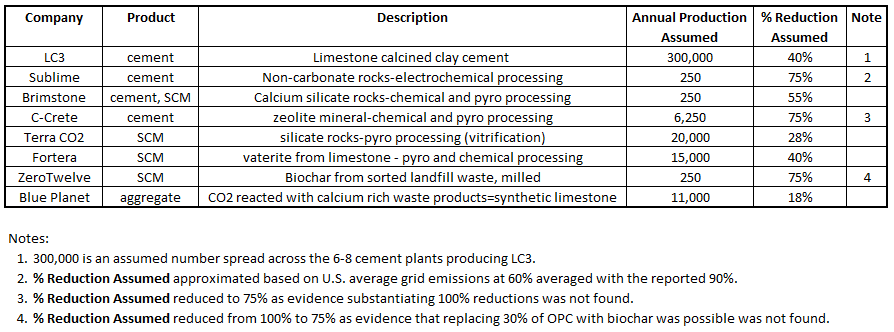
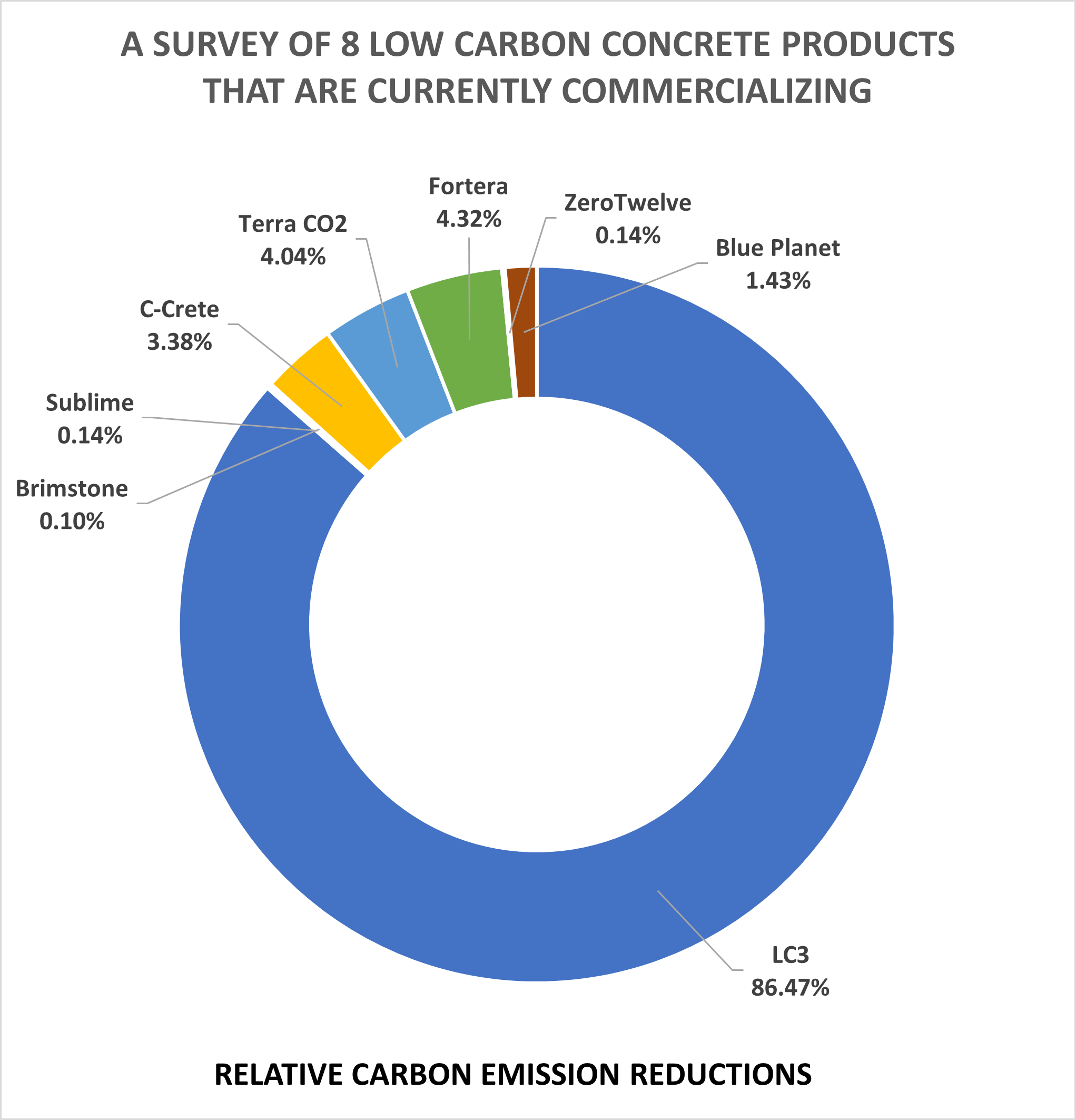
The chart below presents these results in graphical form. The carbon emissions fractional % used for each product was computed as follows:
(annual production x % reduction in emissions)/(total reduction in emissions for the 8 products)
CONCLUSIONS
Progress is being made on many fronts as indicated by the number of companies involved. The 8 products covered in this article are all beginning to be used in the U.S., either for pilot pours or production pours. These firms are incredibly enthusiastic about their products making it challenging to accurately separate out the baseline information for an objective comparative study like this one.
The carbon emission reductions targeted by these products tend to fall in the 40-70% range which is a strong reduction from current OPC emissions, especially when the products are economically scalable. Environmental Product Declarations are the best proof of claim for the products, and while many have EPDs underway, and one (LC3) has published an EPD, no other results are available in open source documents.
All of these products have been in development for at least 5-10 years and it is clear that the effort to reduce the carbon emissions of concrete is demanding of resources. Reducing all carbon emissions from concrete would be approximately equivalent to removing all fossil fuel consumption of cars, motorcycles and trucks. The efforts required are monumental and the recent cutbacks in federal funding of research and awards has deeply impacted the pace of development in this sector. A few large corporations such as Microsoft and Amazon have stepped up to support commercial projects, but this private sector effort has a long way to go in helping this sector succeed in making meaningful reductions in carbon emissions from concrete.
REFERENCES:
1. 70+ Startups Working on Cement 2.0, October 13, 2025. https://hacksummit.beehiiv.com/p/70-startups-working-on-cement-2-0
2. Shaping a sustainable path: Exploring opportunities and challenges in carbon capture and utilization in cement and concrete industry, Danieli et al., https://www.sciencedirect.com/journal/cement, 2025.
4. Global Cement, December 19, 2025. https://www.globalcement.com/news/item/19621-ash-grove-cement-tests-calcined-clay-cement-on-road-project-in-nebraska
5. Hylton, J., Hugen, A., Rowland, S.M. et al. Relevant biochar characteristics influencing compressive strength of biochar-cement mortars. Biochar 6, 87 (2024). https://doi.org/10.1007/s42773-024-00375-6
6. Fadi Althoey, et al. Advancements in low-carbon concrete as a construction material for the sustainable built environment. Developments in the Built Environment, Volume 16, 2023. https://doi.org/10.1016/j.dibe.2023.100284.