Finnish delight: how the world’s happiest country decarbonized its power sector
Apr 1, 2026
Logan Varsano
[An excerpt from a recent article in Climate Trace - for the full article, use this link.]
In mid-March, the World Happiness Report released the 2026 edition of its eponymous annual assessment. And for the ninth year in a row, one Nordic country in particular topped the list as the world's happiest: Finland.
In tandem over the past decade, the country has also accomplished a steep decline in its greenhouse gas (GHG) emissions. While almost every sector of Finland's economy has seen emissions reductions, nowhere has that been more evident than the power sector. Finland already boasted one of the lowest per-capita emissions rates from electricity generation of any European country. But between 2016 and 2025, emissions from electricity generation fell a further almost-80%, from almost 15 million to ~3 million tonnes annually.
According to Climate TRACE data, Finland's power sector saw a larger COVID-related drop in emissions in 2020 vs. 2019, followed by a small rebound in 2021 vs. 2020, but then the country's power sector emissions resumed their decline. This was no accident. Finland's Climate Change Act entered into force in 2022, with major emissions reduction targets for 2030, 2040, and 2050, and a carbon neutrality target by 2035.
Let's take a closer look at how the power sector has evolved for this European nation that shares a 1,300-km border with Russia.
Structural changes to Finland's electricity generation fleet
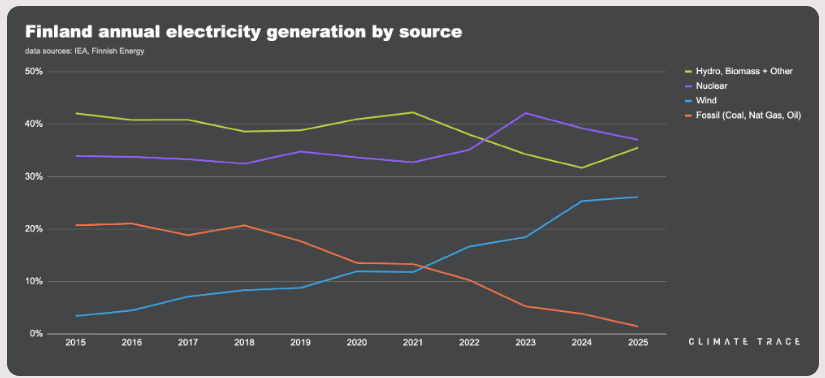
Over the past few years, a confluence of three structural changes in Finland's power sector have helped the nation achieve a nearly 95% carbon-neutral electricity mix:
The near-total phaseout of fossil-fueled electricity generation from coal, oil, and natural gas (accounting for less than 4% of generation in 2024),
Substantial increases in emissions-free generation from nuclear and wind power (totalling a combined 64.5% of generation in 2024),
And the remaining balance coming from a combination of legacy hydropower, biomass or biofuel power plants, and waste-to-energy projects.