
My new NYT op-ed on climate change risk
We’ve made real progress bending down the curve of emissions, but risks remain far too high for complacency
Sep 22, 2026
The world has made real progress in steering away from some of the darkest climate futures where global emissions doubled (or more) this century. But as David Wallace-Wells and I note in today’s New York Times, we are not out of the woods yet, and climate uncertainty is not our friend.
We hear a lot about central outcomes of climate change. For example, under the new "medium" scenario (e.g. current policies continuing), the world warms around 2.9C by 2100. But these numbers mask some massive uncertainties in how the climate actually responds to our emissions.
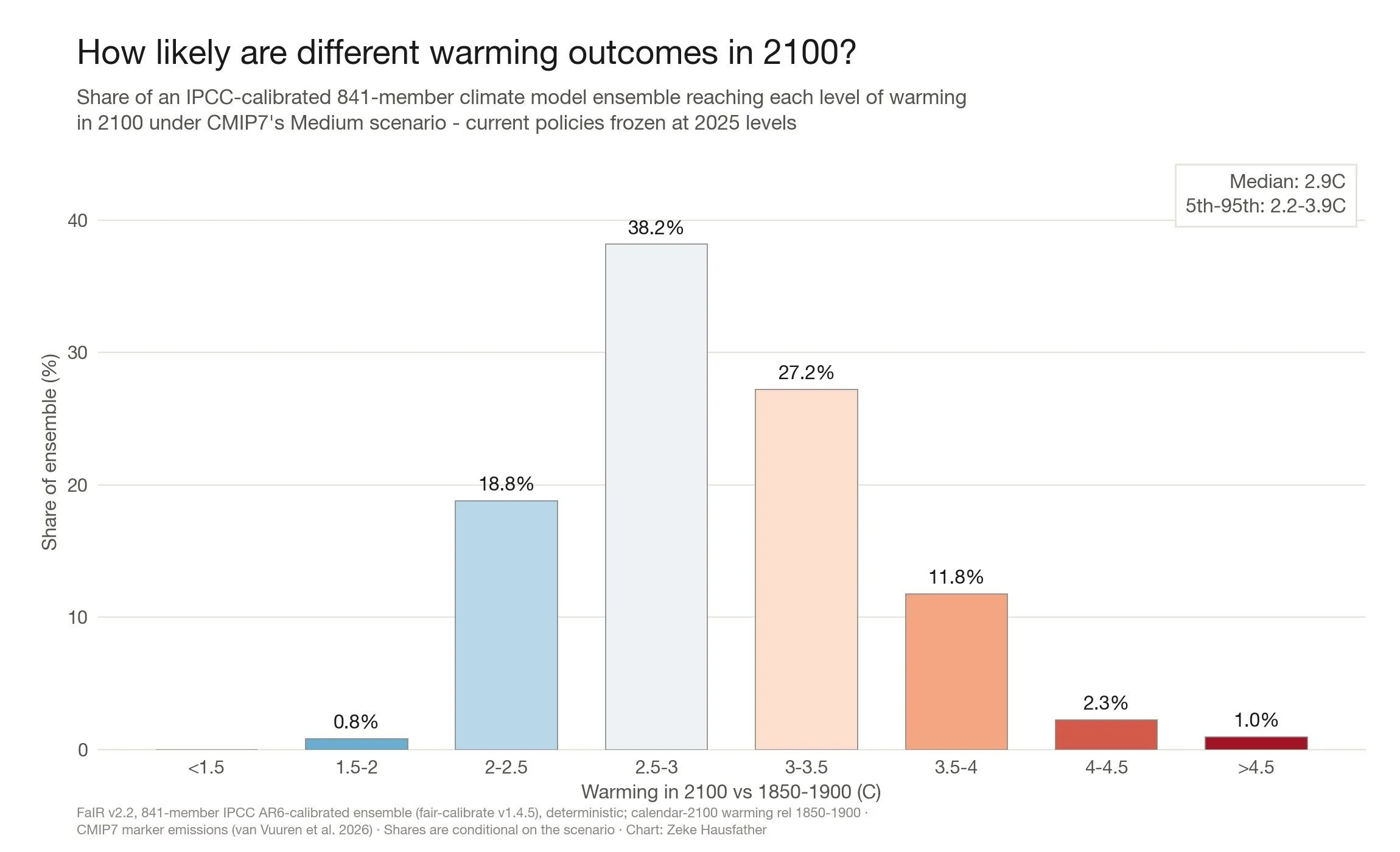
These arise from two factors: carbon cycle feedbacks – how the biosphere and ocean’s ability to absorb carbon changes as we emit more and the world warms, and climate sensitivity – how the interplay of feedbacks like water vapor, clouds, snow and ice, etc. respond to warming.
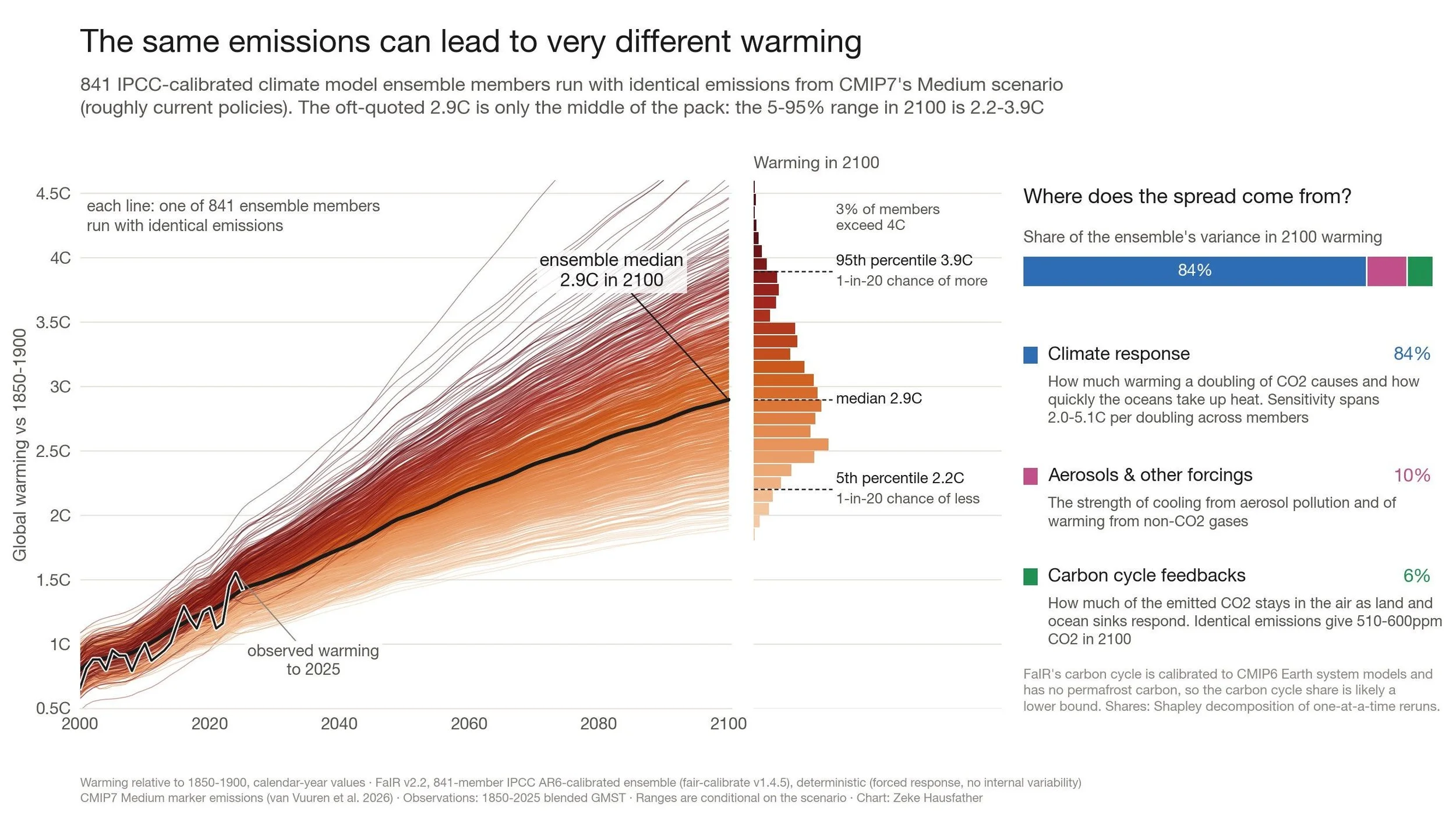
So while we think we are heading toward just below 3C today, we could really end up at 4C if we role 6s on the proverbial climate dice. Its more useful to treat climate outcomes as a set of risks – the odds of the world warming by 2C, 3C, or 4C over time – rather than a deterministic outcome.
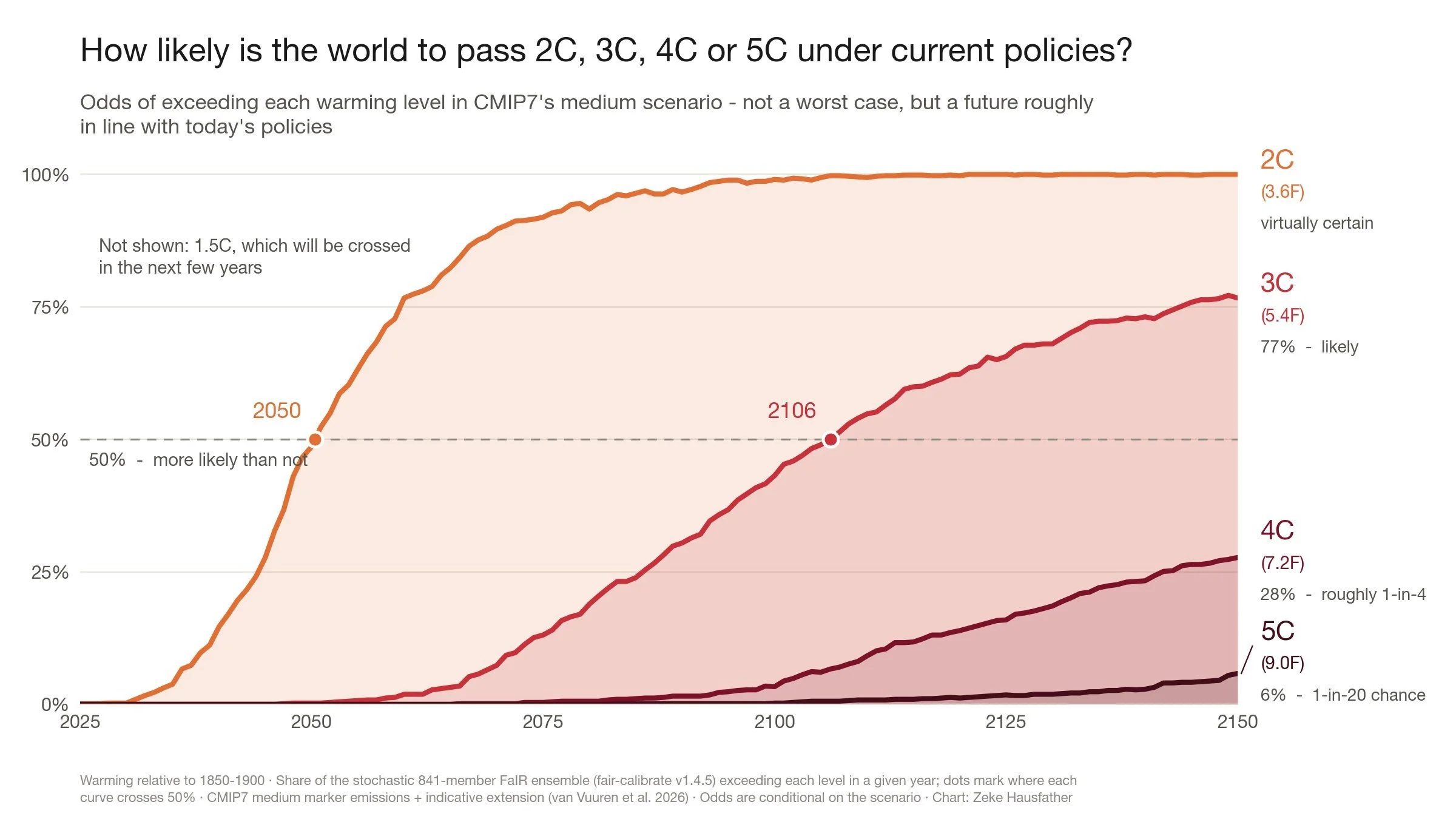
And on the path we are on today those odds are deeply worrying. Its virtually certain we reach 2C by 2100. By 2150 we have a 77% chance of being above 3C, a ~30% chance of being above 4C, and a 6% of more than 5C warming.
As the climate scientist Wally Broecker memorably put it, “the climate is an angry beast and we are poking it with sticks”. The more we push the climate system past where its been for the past few million years, the bigger the risks of larger changes becomes.
These numbers might sound small (particular to US audiences who are used to thinking in Fahrenheit). But global average numbers mask much larger regional changes. The middle of the past ice age was only around 6C cooler in global average temperatures.
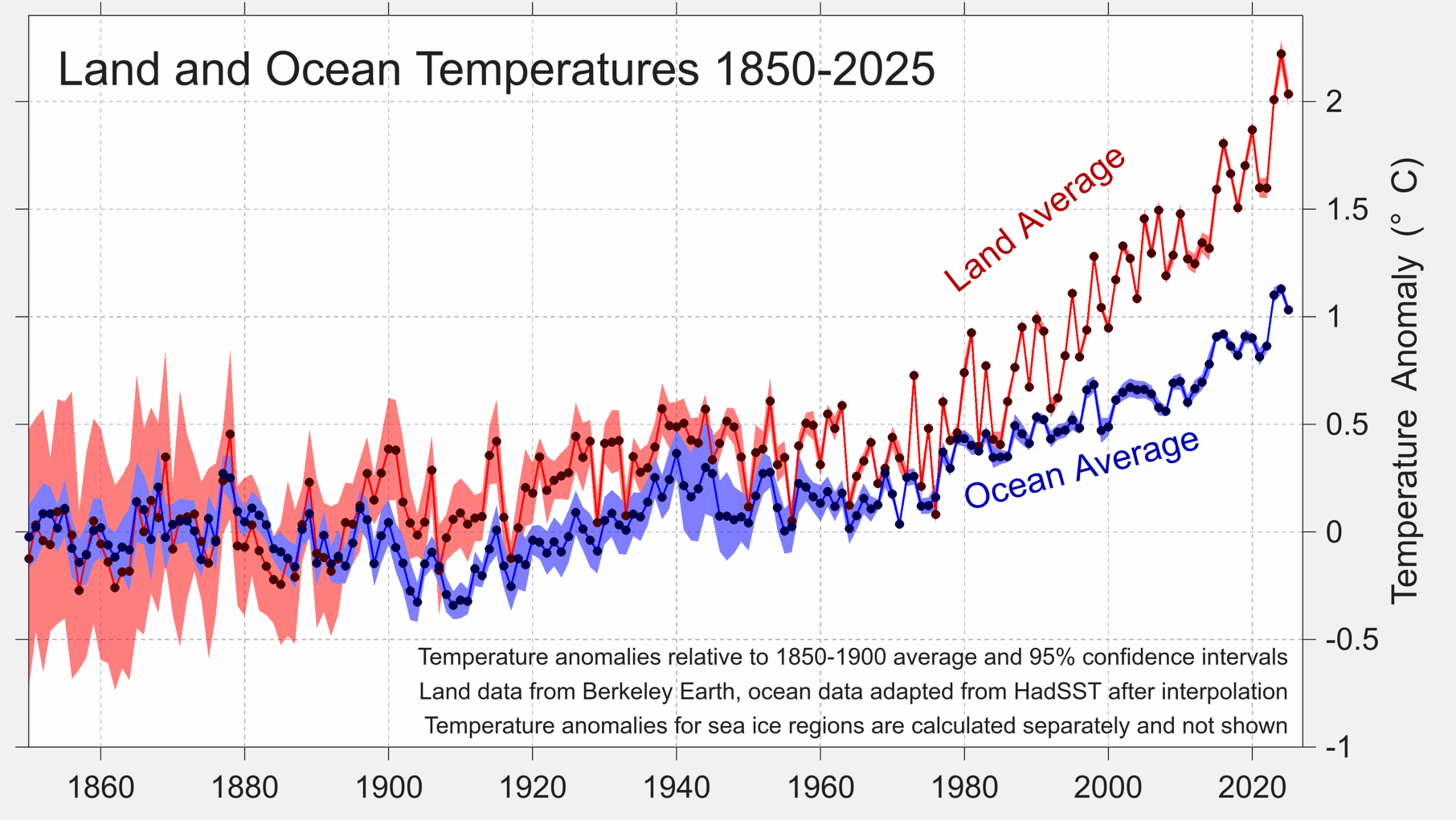
Parts of the world are warming much faster. The global land (where, its worth noting, we all happen to live) is warming around 50% faster than the world as a whole, and has already passed 2C.
There is also no guarantee that we will stay in a current policy world. While I hope that countries will strengthen climate action over time, as we’ve seen in the US its also possible to directly subsidize fossil fuels and put up barriers to clean energy deployment.
In a world of policy reversal and active support for fossil fuel burning (the CMIP7 “High” scenario), we could end up well above 3C by 2100, have a ~70% chance of >4C by 2150, and a 30% chance of over 5C.
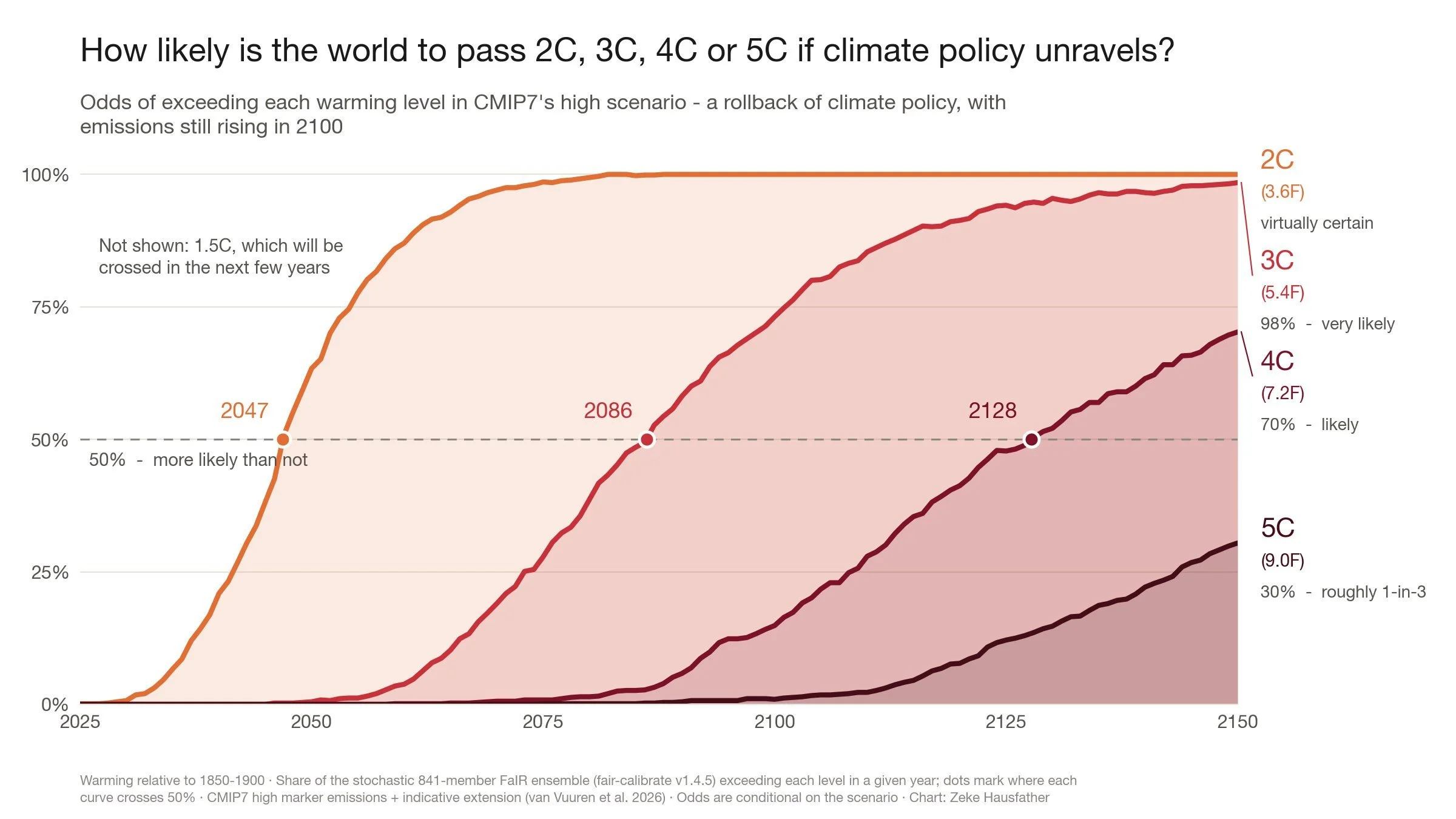
The progress we made in moving away from higher emissions futures should tell us that progress is possible. But it shouldn’t breed complacency; the risks remain far too high and grow with each molecule of carbon emitted. The world still isn’t nearly concerned enough.
Thanks for reading The Climate Brink! Subscribe for free to receive new posts and support our work.