
Cement Basics
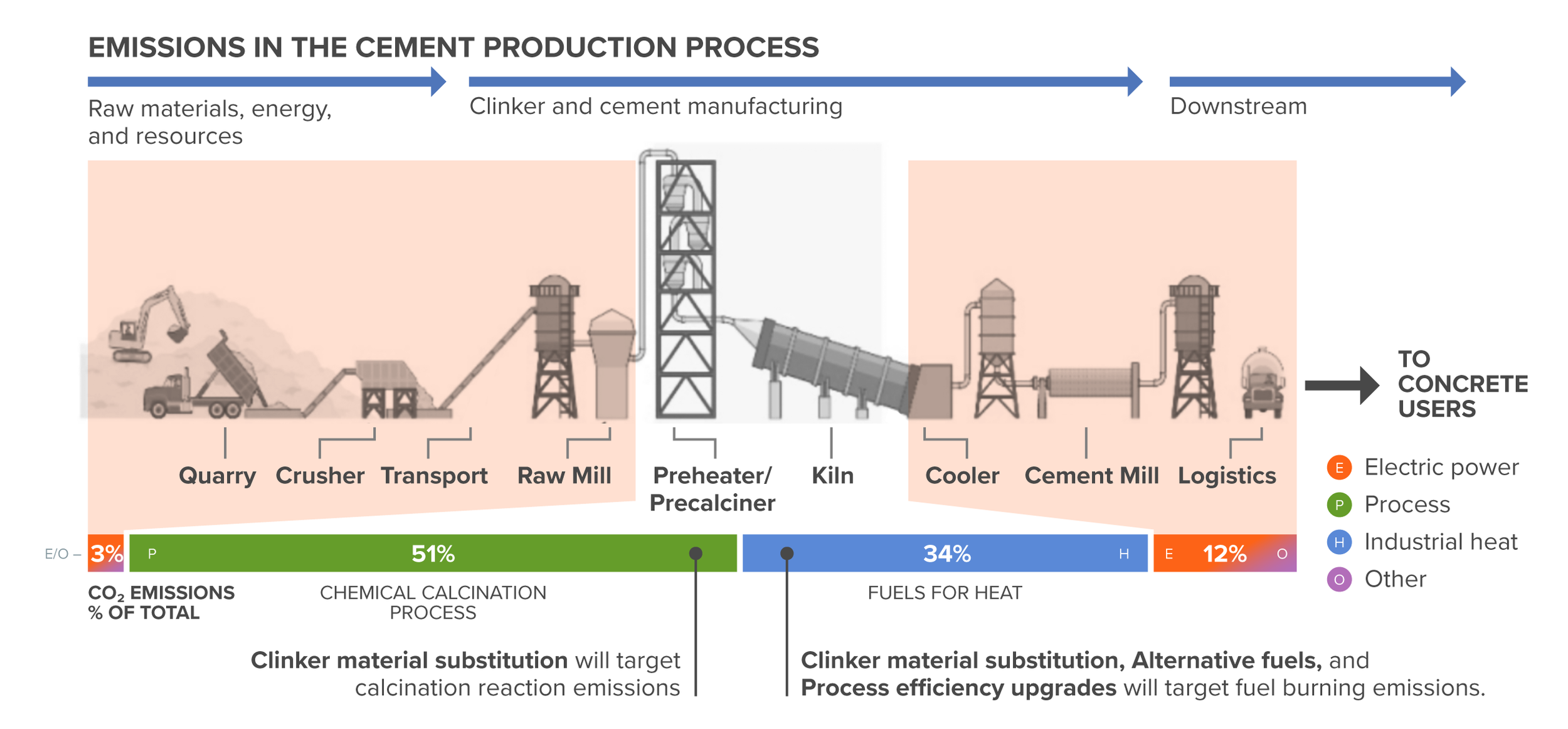
Source: Goldman, S., Majsztrik, P., Sgro Rojas, I., Gavvalapalli, M., Gaikwad, R., Feric, T., Visconti, K., & McMurty, B. (2023). Pathways to commercial liftoff: Low-carbon cement. U.S. Department of Energy.
Portland and Blended Cements
Both portland and blended cements are hydraulic cements, that is, they react chemically with water and can do so while under water. There are several types of hydraulic cement, each of which lends itself to particular uses.
All cement products are composed of specific combinations of calcium, silica, iron and alumina and small amounts of additives to achieve a desired profile of properties (e.g., strength, color).
Calcium is sourced from limestone, CaCO3, which breaks down into Calcium Oxide, a solid, and CO2, a gas in the Preheater/Precalciner tower. About 51% of the CO2 from Cement Production is released at this point.
Silica (SiO2) is sourced from sand.
Iron (Fe) is sourced from iron ore
Alumina (aluminum oxide, Al₂O₃) is sourced from clay.
Clinker, the principle intermediate manufactured product within cement production is stored in the tank between the kiln and the cement mill.
Types of portland cement are:
Type I: for general use applications
Type II: for use when concrete will be exposed to moderate sulfate conditions
Type III: for use in applications requiring high early strength
Type V: for use when concrete will be exposed to more severe sulfate conditions
Portland cements conform to specification ASTM C150.
Blended Cements
Blended cements are mixtures of portland cement and other materials like limestone, blast-furnace slag, or pozzolans (for example, fly ash, silica fume, or natural pozzolans). Blended cements have a lower carbon footprint than portland cements and therefore will reduce concrete’s carbon footprint and can enhance durability. All of these base cement types are suitable for general concrete applications, and special properties like moderate or high sulfate resistance can be verified through testing.
Types of blended cement include:
Type IL: Portland-limestone cement (PLC)
PLC is one of four blended cement types described in ASTM C595, Standard Specification for Blended Hydraulic Cements, and its AASHTO counterpart, M 240. For portland-limestone cements (PLC, or Type IL), ground limestone is included as a cement ingredient at quantities from 5% to 15%, which is up to 10% higher limestone content than portland cement. PLC reduces carbon footprint by up to 10% when replacing portland cement in concrete mixtures. In mid-2023, total shipments of portland-limestone cement (PLC) across the U.S. exceeded those of portland cement (ASTM C150, AASHTO M 85), making PLC the dominant cement type for general concrete construction.
Type IP: Portland-pozzolan cement is a hydraulic cement in which the pozzolan constituent is up to 40 % by mass of the blended cement.
Type IS: Portland blast-furnace slag cement is a hydraulic cement in which the slag constituent is up to 95 % by mass of the blended cement. Portland blast-furnace slag cement with a slag content equal to or exceeding 70 % by mass, is permitted to contain hydrated lime.
Type IT: Ternary blended cement shall be a hydraulic cement consisting of an intimate and uniform blend produced either by intergrinding, by blending, or a combination of intergrinding, and blending Portland cement clinker or Portland cement with (1) two different pozzolans, (2) slag and a pozzolan, (3) a pozzolan and a limestone, or (4) a slag and a limestone. Ternary blended cement Type IT(S≥70) shall have a maximum limestone content of 15 % by mass and is permitted to contain hydrated lime. All other ternary blended cements shall have a maximum pozzolan content of 40 % by mass of the blended cement, a maximum limestone content of 15 % by mass of the blended cement, and the total content of pozzolan, limestone, and slag shall be less than 70 % by mass of the blended cement. Any slag, pozzolan, or limestone used as ingredient in Portland cement used to manufacture a blended cement shall be included in the total amount of those materials.
All of these base cement types are suitable for general concrete applications, and special properties like moderate or high sulfate resistance can be verified through testing. When special properties are applicable, additional descriptors are appended the type designation. For example, Type IL(MS) indicates a moderately sulfate resistant portland-limestone cement.
Blended cements conform to specification ASTMC595.
References:
Portland Cement Association (PCA) Environmental Product Declaration, Blended Hydraulic Cement, 2023.
American Cement Association (ACA)